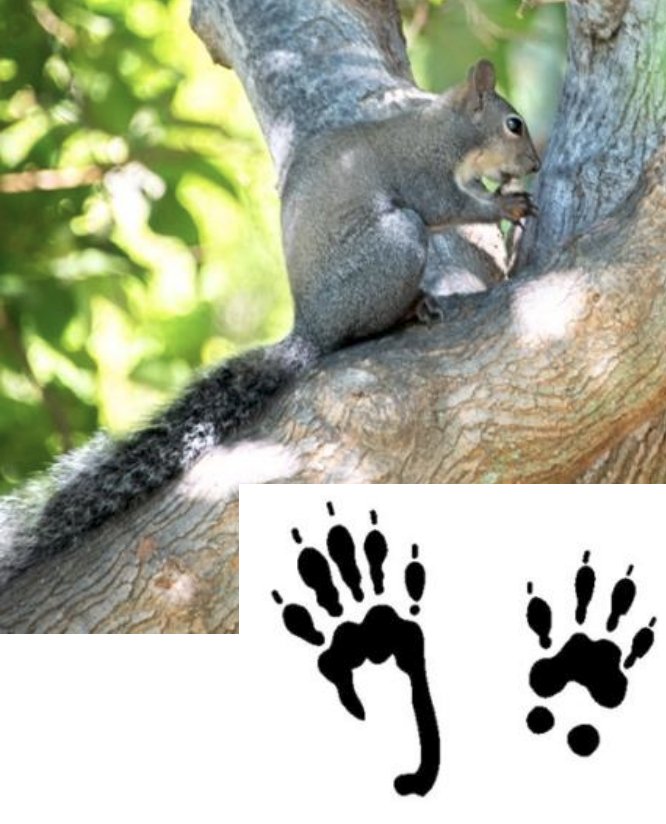
Ground & Grey Squirrel
Two kinds of native squirrels live around camp. The easiest way to tell them apart: if it runs into a hole in the ground, it's a ground squirrel. If it runs up a tree, it's a gray squirrel.
California Ground Squirrel
The California ground squirrel has brownish-gray fur speckled with lighter flecks, and a pale, silvery patch over its shoulders that looks a little like a cape. Its tail is bushy, but not as big and fluffy as a tree squirrel's.
Ground squirrels live in burrows in open, grassy areas, often in groups. They are active during the day and like to stand up on a rock or mound near the burrow entrance to watch for danger. When one spots a predator, it gives a sharp chirp or whistle to warn the others.
Adult California ground squirrels are highly resistant to rattlesnake venom, especially where rattlesnakes are common, and will boldly confront a snake they see as a threat.
They eat seeds, acorns, grasses, fruit and some insects, carrying extra food back to the burrow in their cheek pouches. During the hottest, driest part of summer and the coldest part of winter, many ground squirrels go into a long, deep sleep inside their burrows. Their old burrows also make homes for other animals, such as burrowing owls, snakes and rabbits.
Western Gray Squirrel
The western gray squirrel is one of the largest tree squirrels in North America. It has a silvery-gray back, a white belly and a huge, bushy tail edged in white. It spends most of its life in oak and pine trees.
Gray squirrels build round nests of sticks and leaves, called dreys, high in the branches, or move into a hollow in a tree. They do not hibernate, so you can see them all year, usually during the day. They are shy and will quickly race up a trunk and hide on the far side if they see you.
Acorns are their favorite food, along with pine seeds, nuts and mushrooms. In the fall they bury acorns one at a time to eat later. Any acorns they forget can sprout, so gray squirrels help plant new oak trees.
Look-alike
In towns and parks you may also see the eastern fox squirrel, which has a reddish-orange belly. It is not native to California; people brought it here, and it now competes with the native gray squirrel.